
'Precious Cups', 2025-2026
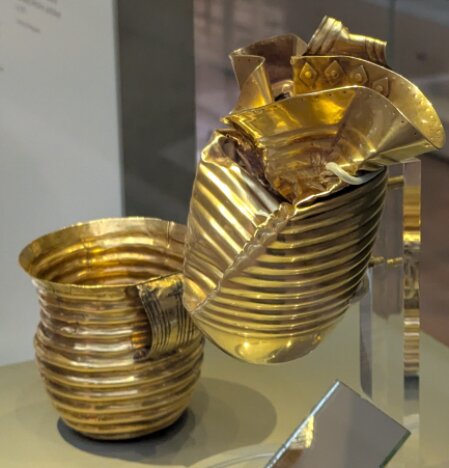
My 'Precious Cups' series is a collection of vessels and sculptural works inspired by creative research into a group of early Bronze Age vessels, known collectively as 'precious cups'. Sometimes an artefact that you've seen lots of times, speaks louder to you on a particular day. The crumpled form of the gold Ringlemere Cup suddenly captivated me in January 2025; its stunning original craftsmanship, but also the brutality of its afterlife and discovery. The striking undulating form, rivets and linear embossed design made even more breath-taking amidst the damage. Crafted from precious materials, predominantly gold, silver and amber, with rounded bases and thin and fragile handles, 'precious cups' have been found within ceremonial landscape and funerary contexts along the coasts of Southern England and North West Europe. The vessels are thought to have played a role in rituals and social networks relating to seaborne exchange of materials and ideas during the early Bronze Age, including cosmological beliefs around the sun.
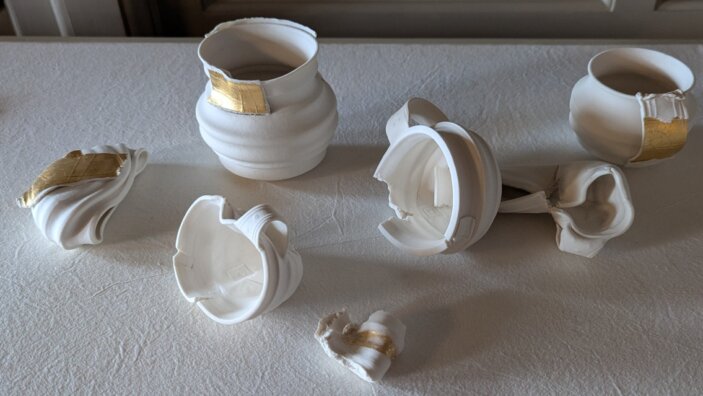
This exploration has developed a series of crumpled and distorted porcelain vessels with delicate handles, which explore the artefacts and their associated archaeological contexts and landscapes. The form of the ancient vessels is often dictated by their materiality; with the metal 'cups' being more representative of chalices and the amber ones being more cup-like. My porcelain vessels referenced a domestic well-loved cup; made precious through its use at intimate gatherings, through inherited and created associations with others. These vessels explored how an object can be distorted and 'broken' and yet retain it's essence and produce a desire to 'cup' it in the hand.
One aspect that fascinates me is how these vessels, which related to cosmology and the landscape, and social relationships across vast distances, were often appropriated into intimate and domestic settings on their discovery. These cups that held the light of the sun and whose form - a rounded base and thin, fragile handle - dictated a particular way of holding and passing and emptying, speak of their role in performance and ritual. Forms that were often subverted and normalised in their afterlives. The bases flattened to sit on a shelf; a Cornish tin mine manager's mantelpiece, a German farmer's kitchen table. These vessels of ritual, of the landscape and the cosmos, were made domestic. After its discovery the Rillaton gold cup briefly become part of Queen Victoria & Albert's cabinet of curiosities at The Swiss Cottage, a family hideaway in the woods, at Osborne House. It later found a home on King George V's dressing table at Buckingham Palace - a container for his collar studs. The cup that was eventually presented to The British Museum had a much altered and expanded handle and flattened base from the original form captured in an early engraving. Separated from their ritual, social and landscape context these vessels more easily became containers for things.
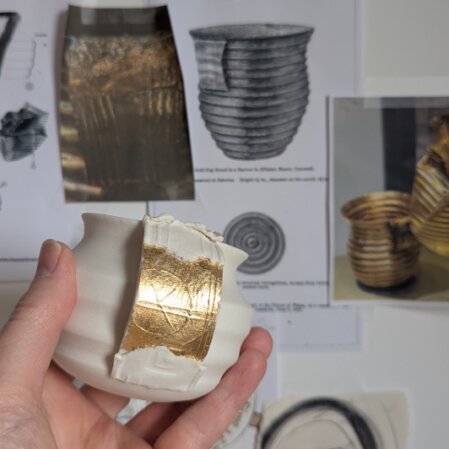
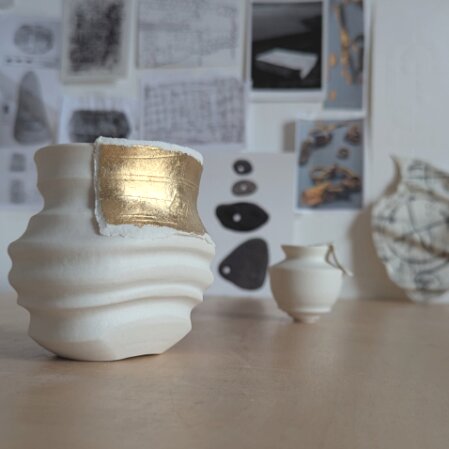
The Ringlemere cup pulled from the plough soil by a metal detector in 2002, led to the discovery of a complex and fascinating late Neolithic and Bronze ceremonial landscape hidden beneath farmland - a rediscovered social arena that cup offers us a tactile connection with. The relationship between these objects and the landscape is reflexive and fluid - both embody time, place and people and their meanings and narratives are intertwined. Even when appropriated into curated or domestic settings they still carry their landscapes with them - the ceremonial landscapes, the movement of the sun and stars and the connections across the sea. Their materiality remembers the sources of their precious raw origins, the mined and traded metal ores and Baltic amber, The agricultural and industrial landscape imprint themselves on the cups - the weight of a stone cist, the wrench of the plough, the farmer's spade and the miners clearing stones. All of these landscapes are held within the vessels, not least the interpretative landscapes of the archaeologist and academic research.